
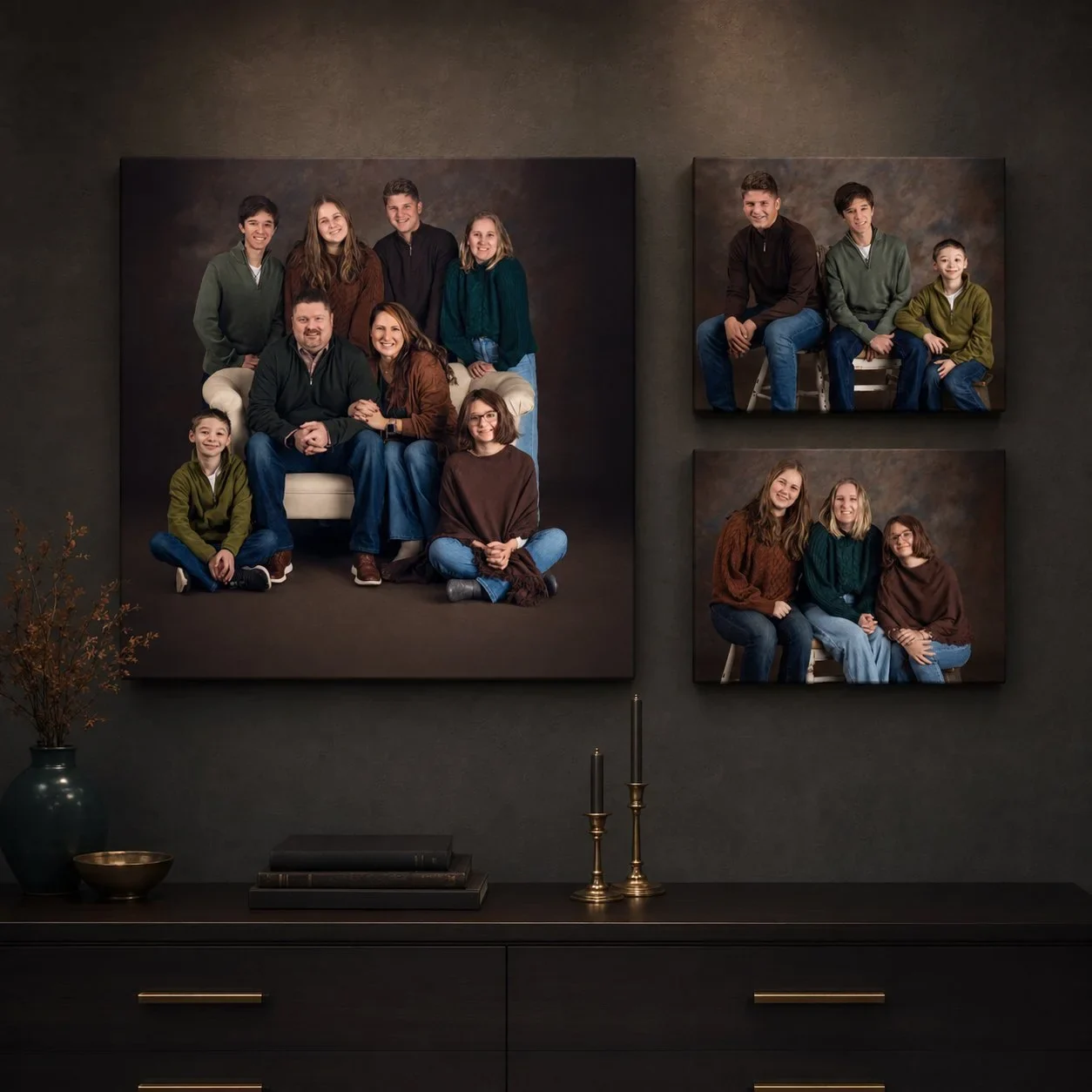
Most of us can find a thousand photographs on a phone and very few on a wall. Choosing one to print feels surprisingly permanent. What if the frame is wrong, the size is too small or the next family photograph is even better? The useful shift is to treat a print as something to enjoy now, not a final decision about your family’s entire visual history.
Start with a place you pass every day. A hallway, landing or living-room wall gives the photograph a job. A picture intended for a bedside table needs a different scale and level of detail than one seen across a room.
Measure before you fall in love with a size Measure the available wall and the furniture below it. Use paper templates to see how different outside frame dimensions feel. Stand back and view them from the doorway. The dimensions of the print alone do not include the frame or mat, so compare the whole finished piece.
Take a straight-on photograph of the wall and share the measurements with your photographer or framer. Ask whether they can show the artwork at a realistic scale. A visualization is most useful when it starts with actual dimensions.
Choose a format around your habits A single large portrait gives the eye one place to land. A series can tell a story across several images, particularly when the frames or spacing provide some consistency. An album suits families who want many moments without finding a wall for each one.
Think about who will handle the finished item. A frequently opened family album is a different choice from a display book that lives on a high shelf. Ask to see material samples, explain how you intend to use the piece and get care instructions for the specific product.
Leave room for the next chapter Choose a display approach you can add to. Matching every future portrait to one unusual frame may create work later. A consistent finish or color family can offer continuity with more flexibility.
Keep the ordered files and any printing permissions organized separately from the display itself. Note the photographer, session date and product information in a folder you can find again. Then let the photograph become part of ordinary life: something the children see on the way to breakfast, not another decision waiting in an online cart.


